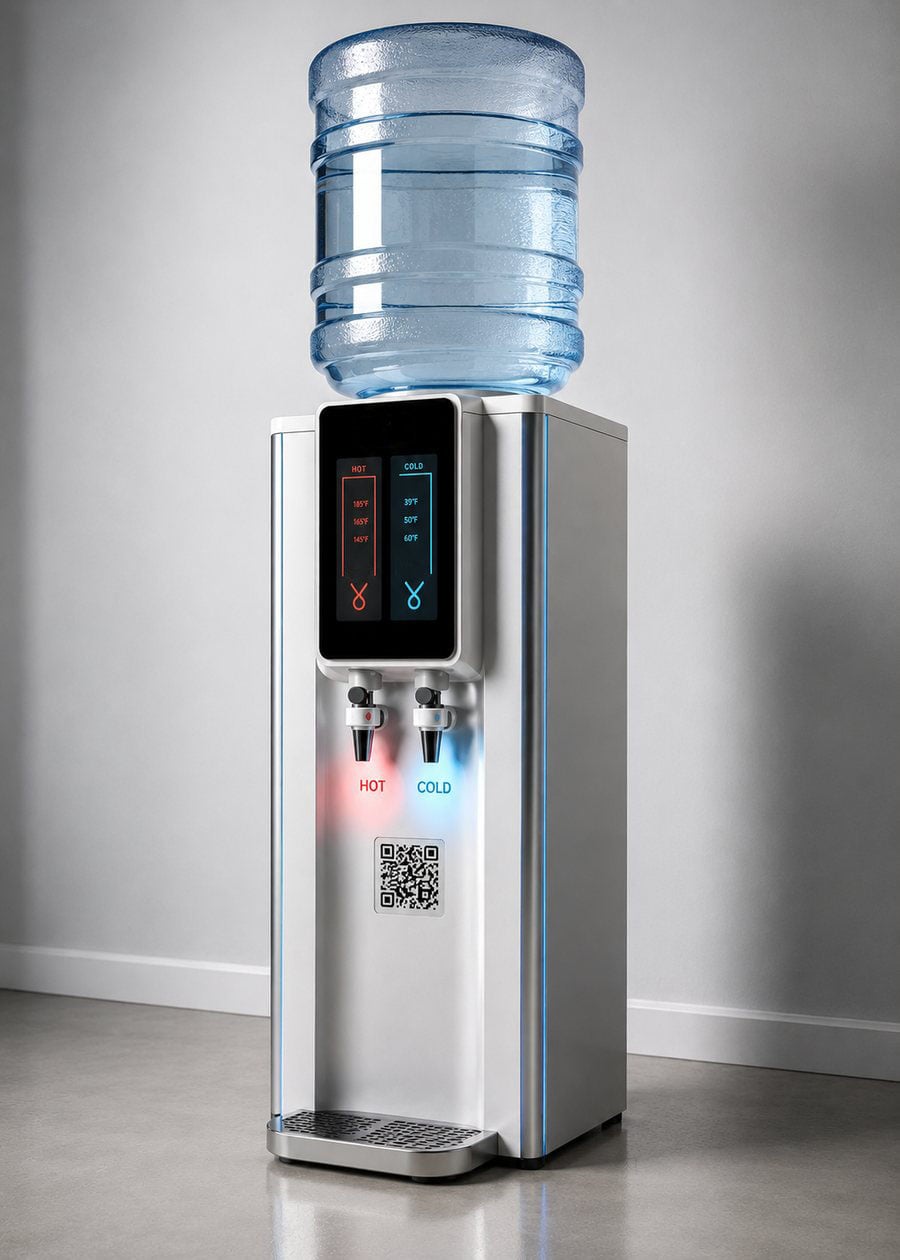
VOICE-CONTROLLED WATER DISPENSER

Speak it. Pour it.
Perfect every time.

Smart Water Cooler modernizes the water cooler your home or office already trusts — adding voice control, exact-measurement pours, and real accessibility, without asking anyone to learn something new.[3][4]

7Core smart features
3Languages at launch
2Phased product configurations
“Hey Smart Cooler — give me one cup of cold water.”
The Product

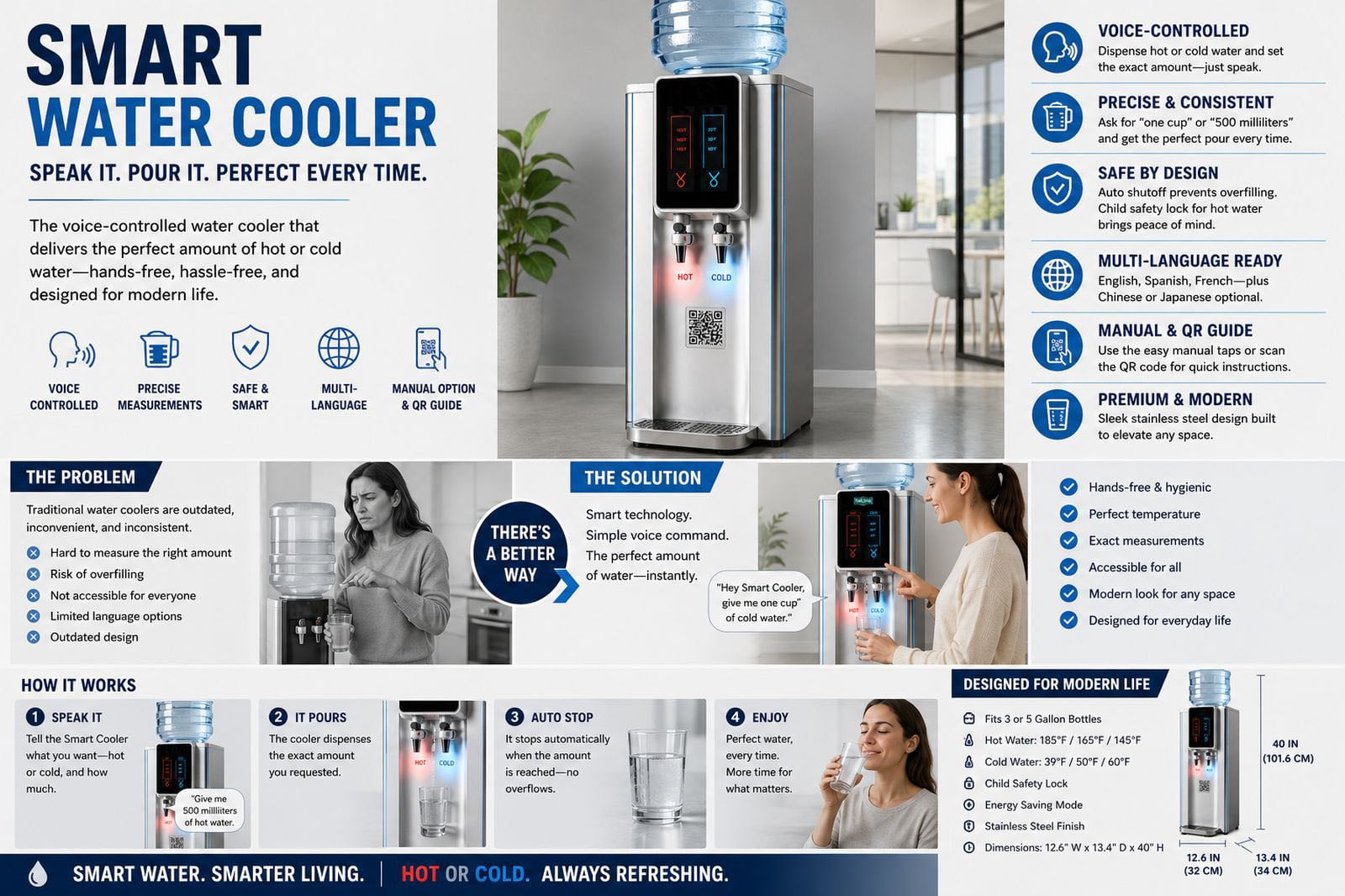
Seven features. One familiar cooler.

Hot-and-cold dispensing is already standard in mainstream water-cooler products.[1] The opportunity is what sits on top of it: voice control, precision, safety, and language support built into a shape people already trust.

🎤

Voice-Controlled Operation

Request hot or cold water without pressing a single button.

🌡

Precise Dispensing

Ask for one cup, or a specific number of milliliters — get exactly that.

🛡

Automatic Safety Shutoff

Stops on its own if a stop command is never given. No overflows.

🌐

Multiple Languages

English, Spanish, and French at launch — Chinese or Japanese to follow.

Manual Operation

Always usable by hand — essential for shared office kitchens.

📱

QR-Code Instructions

An on-unit code links to plain-language setup and usage steps.

💧

Hot & Cold Dispensing

One outlet if manufacturable; dual outlets as the practical fallback.

Select a numbered hotspot to explore each key feature.

How it works

The same four steps, whether the cooler sits in a kitchen or a break room.
1

Speak it

Tell the cooler what you want — hot or cold, and how much.

2

It pours

The cooler dispenses exactly the amount requested.

3

Auto stop

It stops automatically at the target amount — no overflows.

4

Enjoy

Perfect water, every time. More time for what matters.

01 · Product Research

A familiar format, reinvented with voice.

Renandé Flynn’s vision adapts voice-command technology already developed for Aquanauts into a product people already understand — a water cooler — rather than asking them to adopt something entirely new.[5]

The problem with today’s coolers

  • Hard to measure the right amount, leading to waste
  • Risk of overfilling and spills at the tap
  • Button- and lever-operated controls can create accessibility barriers for users with limited hand or arm mobility [3][4]
  • Limited or no language options for non-English speakers
  • Outdated design that hasn’t evolved in decades

Product vision

A more futuristic, “Jetsons”-style experience — keeping the basic water-delivery system familiar while making it significantly smarter through voice. Built for home and office use, with real potential in hospitals and for users with disabilities.

There’s a better way — simple voice command, the perfect amount of water, instantly.

Two phased product configurations

PHASE 1

Traditional Top-Load Cooler

  • Resembles a familiar cooler with a 3- or 5-gallon jug mounted on top [1]
  • Recognizable, trusted form factor that introduces new technology gradually
  • Positioned as the first version to reach the market
PHASE 2

Premium Bottom-Load / Cabinet Cooler

  • Resembles a small cabinet with the water bottle concealed inside
  • An electric pump draws water from the bottle, rather than gravity
  • A more discreet, premium model to follow the traditional version

Branding: naming is intentionally left open — including options inspired by Renandé’s grandchildren — to be finalized once the market opportunity is validated.

02 · Competitor Evaluation

Where the Smart Water Cooler differentiates.

Hot-and-cold dispensing is already established across mainstream water-cooler products.[1] The opportunity is layering voice control, precise dispensing, multilingual functionality, safety, and accessibility onto that familiar category.

Voice as the core innovation

The edge is intelligent voice control layered onto a familiar format — not a new delivery mechanism.

💎

Built on proven technology

The voice-command engine has already been developed and explored through Aquanauts, reducing technical risk.

Accessibility as a differentiator

Hands-free control is a meaningful accessibility direction: federal guidance emphasizes accessible operable controls, while published research shows voice assistants can help users with motor disabilities operate connected devices without physically reaching them.[3][4]

🌐

Multilingual operation

Language support is not a standard feature of existing water coolers today.

Open research questions

Existing voice-enabled coolers on the market · bottled vs. bottleless competitor pricing & share · precise-measurement or multilingual competitors, if any.

03 · Consumer Evaluation

Who the Smart Water Cooler serves.

A broad base of everyday water-cooler users across home and office settings, with a distinct accessibility-driven segment layered on top. Commercial settings represented 48.2% of global water-dispenser revenue in 2025, while bottled dispensers represented 69.9%.[2]

🏠

Home users

Households considering a traditional cooler who want a more modern, convenient experience.

🏢

Office environments

Shared coolers with high-frequency, multi-user interaction — manual mode stays available for all staff.

🏥

Hospitals & care settings

Healthcare is an established water-dispenser application, and hands-free control can improve ease of access for users with mobility limitations.[2][4]

Users with disabilities

Voice-activated dispensing can reduce the need to reach or manipulate physical controls, supporting users with motor disabilities while manual controls remain available.[3][4]

Demand signals to validate

  • Overall market size and demand across home and office settings
  • Household and office adoption rates of water coolers generally
  • Consumer willingness to pay a premium for voice, precision, and accessibility

.

  • Potential price positioning vs. standard and existing smart coolers
  • Perceived value of multilingual functionality among target buyers
  • Interest in a universal design compatible with common water bottles
04 · Derived Position

The band, and how it was reached.

Applying the observed voice premium to the Brio 430 top-load base, the acknowledged V1 form-factor benchmark."bg-navy"

Four derivations, two methods, against MSRP and street.
Method Calculation Result
Percentage premium, MSRP $269.99 × 1.52 $410
Percentage premium, street $188.99 × 1.65 $312
Absolute premium, MSRP $269.99 + $242.70 $513
Absolute premium, street $188.99 + $178 $367

Why this band

$399 sits above every mainstream bottled cooler, which is the point — it signals a different product rather than an expensive version of the same one. It also stays below the U by Moen's $450 street price, so the Smart Water Cooler is never the most expensive voice-controlled water product a buyer is weighing.

Where it breaks

Below roughly $350 MSRP the unit cannot absorb standard retail discounting without eroding the margin that funds the voice hardware. Above roughly $500 it competes with premium bottleless and point-of-use systems on a price basis it would lose.

Test the position

Set a base cooler price, a voice premium, and an expected retail discount.

Resulting MSRP
$410
Street price after discount
$308 realized
05 · Leasing model

Sell the pour, not the appliance.

A $399 price tag is a decision. Nineteen dollars a month is not. Leasing removes the largest obstacle to a premium price and converts a one-time margin into recurring revenue the category already runs on.

Why it works here

  • The category already leases. Bottleless office coolers rent at roughly $80/month with service included, so no buying behavior has to be invented.
  • It neutralizes the premium. The open question was whether buyers would pay 52% more for voice. On a monthly plan that becomes a few dollars, not $130.
  • Service is the moat. A leased unit is one you keep sanitized, updated and swapped — the contact that makes new languages and accessibility features deliverable after the sale.

One important distinction

The V1 unit is a bottled cooler, so a lease covers hardware and service only — the customer still buys jugs. That is why these rates sit well below the $80 bottleless benchmark, which includes the water itself via a mains connection.

Quoting near $80 for a bottled unit would price the water twice and lose the deal. The right comparison is lease plus jugs against bottleless all-in.

Proposed tiers

Contract value assumes the full term is served.
Tier Rate Term Includes Contract value vs outright
Home Well Water William $19/mo 24 mo Unit, full warranty, software updates. Title transfers at term end. $456 1.1×
Office managed Office Manager Olivia $34/mo 36 mo Unit, install, annual sanitization, next-day swap on failure, language configuration. $1,224 2.7×
Enterprise fleet 10+ units $27/mo 36 mo All of the above, plus priority swap, consumption reporting, multi-site configuration. $972 per unit 2.2×
Accessibility placement Care settings, pilot $39/mo 12 mo Short-term and cancellable, built for procurement cycles that resist capital purchases. $468 1.0×

What the customer actually pays

Monthly all-in comparison, office of 8–10 people.
Option Hardware Water Total per month
Buy a commodity cooler outright $0 after ~$190 $30–$70 $30–$70
Bottleless rental, all-in included included ~$80
Smart Water Cooler, office lease $34 $30–$70 $64–$104

It brackets the bottleless rate rather than undercutting it. That is the honest position, and it is defensible: the buyer gets voice, precision, accessibility and multilingual support that no bottleless unit offers, without plumbing work or a mains connection.

Model the lease

Set rate, term, landed cost, service cost and churn to see contract value, margin and payback against an outright sale at $449.

Expected revenue per unit
$1,014
Gross margin per unit
$655
Cash payback
6 months

Churn is applied monthly on a straight-line basis against the contract term. Landed cost and service cost are placeholders until factory quotes arrive — replace them after the manufacturing-prep spoke.

06 · Earliest Adopter Profile

Two early adopters. One smarter way to get water.

The Smart Water Cooler has a natural role in both home and work life: at home, it can make reliable, fresh-tasting drinking water more convenient; at work, voice activation makes hydration easier when people are moving quickly, multitasking, or have their hands full.

🏠 Home

Well Water William

A homeowner who relies on well water and is frustrated by inconsistent taste and drinking-water quality. He is intentional about what he puts in his body and is willing to pay more for a cleaner, fresher everyday drinking experience.

Well Water William
💧

His everyday challenge

Well water can create an inconsistent drinking experience, pushing William to look for a dependable source of water that tastes clean and fresh every day.

🌿

What he values

Health, quality, consistency, and products that make better daily habits easier. He is less focused on the lowest price and more focused on confidence in what he drinks.

Why Smart Water Cooler fits

A dedicated bottled-water cooler gives William a consistent alternative to drinking directly from the well, while precise dispensing and voice control add convenience to his kitchen and daily wellness routine.

🏢 Workplace

Office Manager Olivia

She manages an office of more than 50 employees and wants everyone to have easy access to fresh, cold water. Her own workday is fast-paced, often moving between meetings with a laptop, notebooks, and other materials in hand.

Office Manager Olivia
👥

Her everyday challenge

Olivia is responsible for keeping a shared workplace comfortable and well supplied while balancing meetings, employee needs, and a long list of operational responsibilities.

What she values

Convenience, reliability, products that serve many people, and small workplace improvements that remove friction from a busy day.

🎤

Why Smart Water Cooler fits

When her hands are full, voice-activated dispensing lets Olivia request cold water without stopping to operate the cooler manually. The same hands-free convenience can benefit employees throughout a high-traffic office.

Built for the kitchen and the break room.

William highlights the value of consistent, convenient drinking water at home. Olivia highlights the value of fast, hands-free access in the workplace. Together, they show how Smart Water Cooler can solve different daily needs with the same familiar product platform.

07 · Unique Value Proposition

The cooler you already know — now listening.

💎

Familiar format, modern intelligence

Keeps the recognizable water-cooler form factor consumers already trust. Voice is the innovation layer, not a reinvented mechanism. Manual operation always remains available.

🛡

Precision, safety & accessibility

Exact-measurement dispensing manual coolers cannot offer. Automatic safety shutoff prevents overflow or waste. Hands-free operation removes a real mobility barrier.

Proven tech, multilingual reach

Built on voice technology already explored for Aquanauts. English, Spanish, French at launch — more to follow. QR-code instructions make onboarding self-serve.

“The water cooler you already know — now listening.”

08 · Minimum Successful Product

V1: the traditional top-load cooler.

The Phase 1 top-load cooler is the Minimum Successful Product — a familiar 3- or 5-gallon format that introduces voice control without asking consumers to also adopt an unfamiliar cabinet design.[1][2]

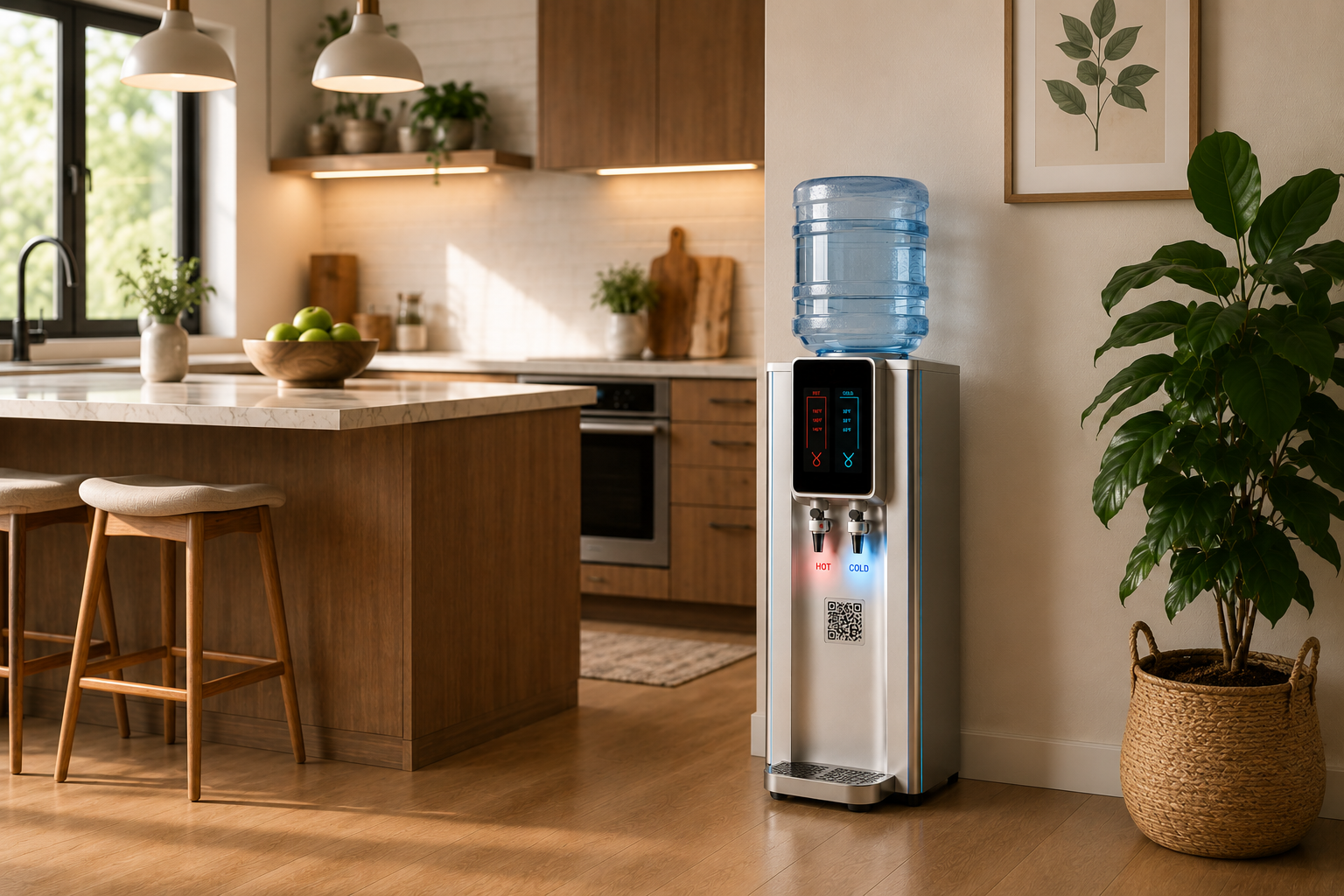
In Home Smart Water Cooler in a modern home kitchen
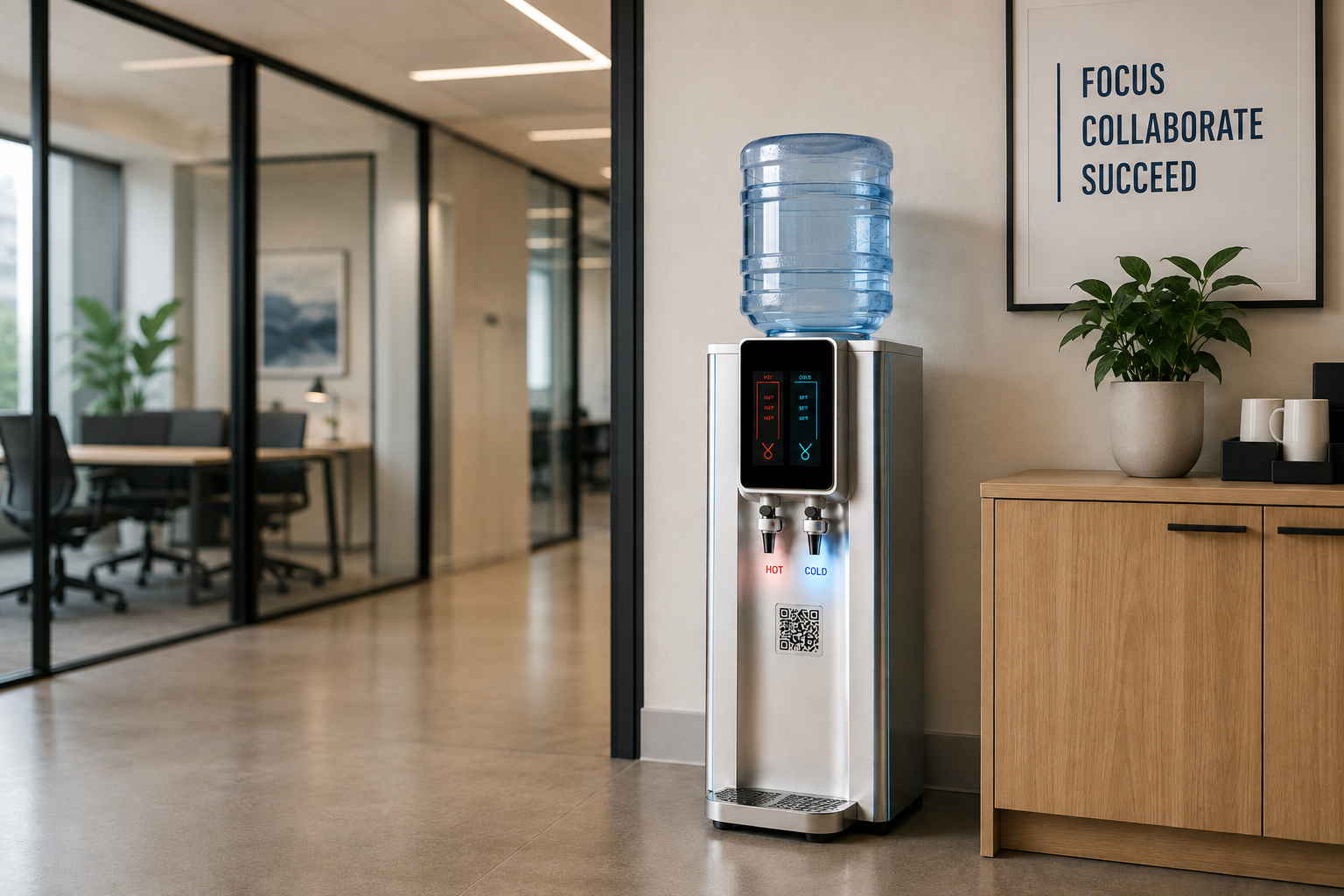
In Office Smart Water Cooler in a modern office


V1 requirements

  • Top-load format compatible with standard 3- or 5-gallon jugs
  • Voice-controlled hot & cold dispensing (single outlet if feasible)
  • Precise, voice-commanded measurement dispensing
  • Automatic safety shutoff on missing stop command
  • Full manual operation available at all times
  • Multilingual voice support: English, Spanish, French
  • QR-code instructions on unit for self-serve onboarding

V2 roadmap

  • Phase 2 premium bottom-load / cabinet cooler with electric pump
  • Expanded language support, including Chinese and Japanese
  • Universal bottle compatibility to broaden adoption
  • Deeper accessibility features from hospital & disability research

Path to market

Market Validation
Patent Search
Patent Application
Patent Pending
Design & Manufacturing with 52 Launch

Estimated costs discussed: approximately $2,500 for a patent search and $6,000–$9,000 for the patent application.[5] Once patent-pending status is established, the concept returns to 52 Launch for a development process similar to the one used for Aquanauts.

09 · 52 Launch Overview

From validated idea to market-ready product.

52 Launch is the execution partner turning the Smart Water Cooler concept into a fundable, buildable product — the same team and process already used to develop Aquanauts.

🔍

Market Validation

Sizing, competitor mapping, pricing, and consumer demand research.

📜

Patent Strategy

Patent search and application guidance ahead of a patent-pending filing.

Product Design

Industrial design and voice-technology integration for both product phases.

🏭

Manufacturing

Sourcing, tooling, and production planning through to first units.

Immediate deliverables

A full market research presentation — sizing, competitive analysis, pricing, and investment considerations — plus the AI-generated concept visuals from the kickoff, targeted for completion in approximately two weeks.

10 · Why Funding Is Needed

Protecting & building the opportunity.

The concept is validated enough to invest in protecting it and moving to design — but the path from here to a shippable product requires capital at each stage before revenue exists to fund it.

Patent protection

An estimated $2,500 for a patent search and $6,000–$9,000 for the application.

Product design & engineering

Industrial design plus integration of the voice-control system into a physical unit.

🏭

Tooling & first production

Manufacturing setup and an initial production run before units reach customers.

📈

Completing validation

Deeper pricing and adoption research to de-risk the investment ahead of larger commitments.

08 · Where The Investment Goes

An illustrative allocation, refined as real quotes come in.

1

Product Design & Engineering

Industrial design and voice integration

2

Tooling & Manufacturing

Setup and initial production run

3

Patent Search & Application

Protecting the concept before scaling

4

Market Validation

Pricing, demand, and adoption testing

5

Launch & Go-to-Market

Bringing V1 to its first customers

Target Raise:
Editable template — enter a target raise and drag each slider. Amounts update live.
Product Design & Engineering ($42,000) 35%
Tooling & Initial Manufacturing ($36,000) 30%
Patent Search & Application ($18,000) 15%
Market Validation & Testing ($14,400) 12%
Launch & Go-to-Market ($9,600) 8%
Patent costs are estimates provided through project counsel; design, tooling, and go-to-market figures are directional and will be refined following the market research phase.[5]
11 · The Ask

Why this is worth backing now.

💎

Proven technology, lower risk

The core voice-command system isn’t unproven — it’s already been built and explored through Aquanauts.

🏠

A category people already trust

The concept builds on an established category used across residential and commercial settings; the new behavior to explain is the voice layer, not the basic water-cooler format.[2]

An underserved, meaningful market

Accessibility is a meaningful design opportunity: accessible-control standards and voice-assistant research both support reducing reliance on fine motor interaction.[3][4]

📜

A clear, de-risked roadmap

Market validation → patent protection → design → manufacturing, with 52 Launch executing each step.

🤝

An experienced execution partner

52 Launch has already taken a comparable concept from idea to development with Aquanauts.

💡

A founder-driven, personal brand

Built into a broader brand ecosystem, with naming tied to family — a story investors and customers connect with.

12 · 52Launch Overview

Managed by experts, all under one roof.

Dan Gonyea
Founder / CEO

Dan Gonyea

Peter Drakulich
Co-Founder

Peter Drakulich

Sean Neal
Head of Client Success

Sean Neal

Kyle Lamson
Head of Design

Kyle Lamson

Ann Fay
Head of Marketing

Ann Fay

Sander Reynolds
Head of Production

Sander Reynolds

Managed by experts + all under one roof = 730+ successful launches.

Why 52Launch

Our expertise.

The Problem

Most founders juggle separate research, branding, design, manufacturing, and marketing vendors. The handoff gaps create delays, rework, and launch risk.

The Answer

52Launch runs a 6-spoke Accelerator that aligns every discipline at once, so the Smart Water Cooler is engineered for the market and the market is prepared for the product.

The Proof Points

10+ years in market, 700+ products launched, 30+ years of manufacturing network depth, and millions in client revenue generated.

The Result

Clients get validated strategy, manufacturing economics, GTM readiness, and a clear decision path before committing to production.

10+Years accelerating founders
700+Products launched to market
30+Years of factory & supplier depth
6Spokes operating as one system
Framework

The 6-spoke force multiplier.

01 · Market Research

Validate demand, audience, category gaps, and positioning inputs before design spend begins.

02 · Brand Creation

Build the naming, identity system, and messaging architecture customers can remember.

03 · Product Development

Translate the concept into manufacturable design, prototypes, and technical documentation.

04 · Manufacturing Prep

Select suppliers, map tooling, model costs, and de-risk production decisions.

05 · Marketing Strategy

Launch with Shopify infrastructure, GTM plans, organic playbooks, and sales assets built.

06 · Bridge Meeting

Consolidate economics, positioning, readiness, and next-step decisions before manufacturing.

Core Advantage

One roof. Fewer disconnects.

Fragmented Route

  • Different vendors optimize for their own scope, not the whole business.
  • Research insights often arrive too late to shape design or brand decisions.
  • Manufacturing and marketing expose expensive gaps after development is complete.

52Launch Route

  • Every spoke informs the others, compressing timeline and reducing rework.
  • The product is positioned for a buyer, not just engineered for a prototype.
  • When manufacturing finishes, the sales story and GTM system are already in place.
What Smart Water Cooler Receives

Deliverables that move from insight to execution.

Strategic Intelligence

Market sizing, competitive mapping, audience personas, positioning statements, and messaging pillars.

Brand System

Naming support, logo package, brand guide, activation plan, and mood boards ready for real-world use.

Manufacturing Package

CAD and tech documentation, DFM-ready detail specs, prototypes, factory alignment, tooling strategy, and cost analysis.

Digital Launch Stack

Shopify foundation, landing page, email capture, automation, and brand-aligned conversion copy.

Go-to-Market Assets

Channel recommendations, organic tactics, paid playbooks, wholesale sell sheets, and creative briefs.

Decision Clarity

Bridge Meeting outcomes covering margins, landed cost, quality plan, product validation, and next actions.

Case Evidence

Real clients. Real success.

Case studies as provided by 52Launch from past client engagements.

EggMazing

Worked with the design team and engineers on a cost-effective, mass-producible design. Leftover funds went to marketing, and EggMazing has sold more than 55 million units.

UnShrinkIt

After being backed by Mark Cuban on Shark Tank, UnShrinkIt came to 52Launch for new packaging and a lower price per bottle, with a cost-effective domestic chemist to mass-produce the formula.

innovo+

The content team captured stunning videos and photos that spoke to the brand's essence, creating a narrative that resonated through a new website and email marketing.

Why The Investor Should Help

A proven playbook behind a market-ready opportunity.

Clear Category Opportunity

The Smart Water Cooler modernizes a familiar category with voice control, exact-measurement dispensing, and accessibility built into the experience.

De-Risked by 52Launch

700+ products launched, 30+ years of manufacturing depth, and a structured prototyping process designed to reduce risk before mass production.

Built for Execution

Research, product development, manufacturing preparation, brand, and go-to-market planning operate together instead of as disconnected handoffs.

Readiness Path

From concept to revenue.

1. Validate the market
2. Build the brand and product
3. Pressure-test economics
4. Prepare the launch stack
5. Decide with clarity

Confirm audience, category gap, demand logic, and positioning; create identity, prototypes, technical specifications, and manufacturer-ready design direction; vet factories, tooling, landed costs, COGS, and margin scenarios; prepare the website, capture flows, GTM plan, wholesale material, and asset requirements; then use the Bridge Meeting to determine readiness before manufacturing commitment.

Sources & Notes

Where this data comes from.

Like the C² Sippy investor page, independently verifiable claims are numbered throughout the page and tied to the references below. Product-specific assumptions, Aquanauts history, patent estimates, funding allocations, and 52Launch case evidence remain identified as primary research or internal estimates where public verification is not available.

Competitive & category benchmarks

  1. 1

    Brio 430 Series Hot & Cold Top-Load Water Cooler

    Current mainstream benchmark confirming hot-and-cold dispensing, 3- and 5-gallon bottle compatibility, no-plumbing top-load operation, and a child-safety lock. Used to support statements about the familiar V1 form factor and established category features. View source ↗

  2. 2

    Grand View Research — Water Dispenser Market, 2026–2033

    Reports a $3.6B global water-dispenser market in 2025, with bottled dispensers representing 69.9% of revenue, commercial applications 48.2%, and North America 37.5%. The report projects the market to reach $6.5B by 2033. Used as category-size and segment context, not as proof of demand for this specific voice-enabled concept. View source ↗

Accessibility & voice-control evidence

  1. 3

    U.S. Access Board — Drinking Fountains, Water Coolers & Operable Parts

    Federal accessibility guidance states that fixed or built-in water coolers and bottle fillers must meet operable-parts requirements, including accessible reach and controls usable with one hand without tight grasping, pinching, twisting of the wrist, or more than 5 pounds of force. This supports accessibility as a legitimate design consideration; it does not mean voice control itself is required for ADA compliance. View source ↗

  2. 4

    Journal of Medical Internet Research — Accessibility of Voice Assistants With Impaired Users

    A peer-reviewed mixed-methods study found that users with motor, linguistic, and cognitive impairments can effectively interact with voice assistants under appropriate conditions. The research also describes how voice assistants can operate connected home devices without requiring users to physically reach the device. Used to support the hands-free accessibility thesis, not to validate this specific product. View source ↗

Primary research & internal estimates

  1. 5

    Project Kick-Off Transcript & 52Launch project materials — August 12

    Renandé Flynn’s original problem statement, Aquanauts technology history, desired voice commands, multilingual launch vision, top-load and bottom-load phases, QR-code onboarding, naming direction, hospital/disability use cases, and patent-cost figures were captured through the 52Launch discovery process. The approximately $2,500 patent-search estimate and $6,000–$9,000 application estimate were provided through project counsel and are not public market benchmarks.

Important note: No public source reviewed here independently proves that there are zero voice-enabled, multilingual, or precision-measurement water coolers in the market. Those competitive-white-space claims should remain preliminary until the formal 52Launch market-research phase is complete. Likewise, the funding allocation, product specifications, and go-to-market assumptions shown on this page are planning inputs rather than independently validated benchmarks.

Let’s bring the Smart Water Cooler to life.

Speak it. Pour it. Perfect every time.