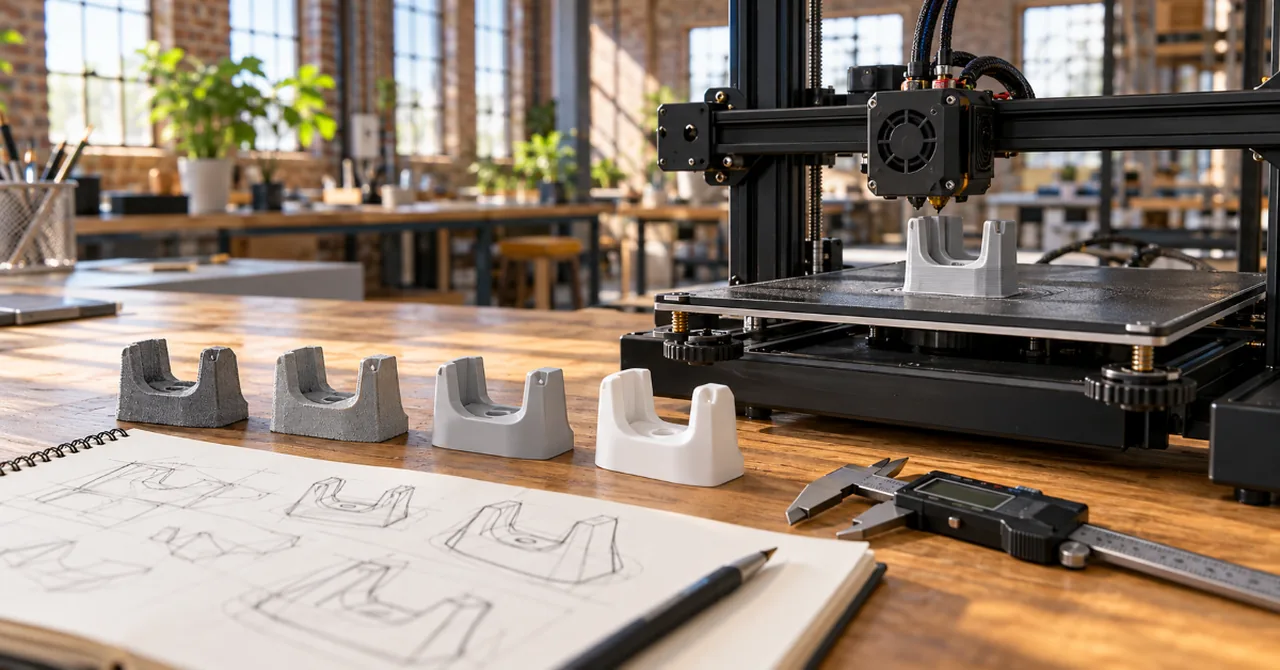
Inventors ask "how many prototypes do you need?" because every round costs time and money. Plan for 3 kinds before anyone cuts a mold: a proof of concept, a looks-like model and a works-like model. You may not need all 3, and the last 2 are often built side by side. After the mold, plan for at least 1 production sample from the factory before you place the full order. A simple product gets through those stages in fewer rounds. A product with a mechanism or electronics takes more, because each round answers a different question.
The 52Launch team has taken 730+ consumer products to market, working out of Saxonville Mills in Framingham, Massachusetts. The number that decides your budget is the split between print rounds before the mold and factory samples after it. The math is lopsided. Design errors cost hundreds of dollars to fix. Manufacturing errors cost tens of thousands, and you usually find them after the money is spent.
A product goes through up to 3 kinds of prototype before tooling: a proof of concept to show the idea works, a looks-like model to judge size and feel, and a works-like model to test the mechanism. After the steel mold is cut, the factory's trial shots, called T1, T2 and so on, become the final prototype rounds before production.
Are you counting rounds or units?
Rounds and units are 2 different numbers: a round is a new version of the design, and units are the copies you build of 1 version.
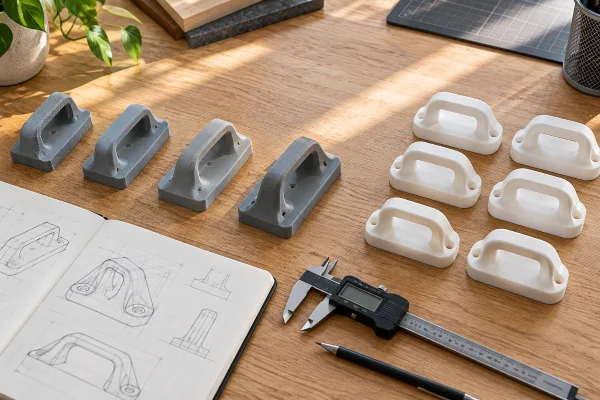
When 2 people argue about how many prototypes a product needs, they're often counting different things. One means versions. The other means copies for testers, pitch meetings or a lab.
| Rounds | Units | |
|---|---|---|
| What it counts | New versions of the design | Copies of 1 version |
| What raises it | Open questions about fit, function or cost | Testers, buyer and investor pitches, lab samples |
| How it's built | 3D prints and machined parts, then factory trial shots | Extra copies of the same file, or factory samples |
| Example | KlockIt Golf went from a homemade rig to a new ball core | A children's product needs enough identical samples for a third-party lab |
Kids' products show why units need their own line in the budget. Under federal certification rules, a manufacturer has to send a third-party lab enough samples to give a high degree of assurance that the product meets every safety rule that applies. Those samples have to be the product itself or identical to it in all material respects.
So budget both numbers. Ask how many versions it'll take to work, then ask how many copies each version needs.
What a printed prototype can tell you
Prints answer the questions you can settle by hand: does the idea work, does it fit and does it feel right? They're cheap to change, so most of your rounds belong here.
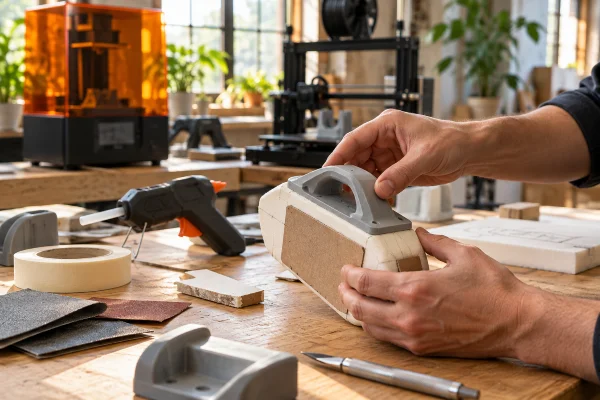
In our rapid prototyping studio, trained industrial designers run the 3D printers in the same building where they drew the file. A change made in the morning can be in your hand the same week. Send that part to an outside print bureau and every change costs days of waiting. And when a part fails, it comes back with an explanation and a fix.
The method depends on the part: 3D printing, CNC machining or a handmade foam model. What matters here is the job each prototype does.
Proof of concept
A proof of concept answers 1 question: does the idea hold up at all? It doesn't need to look good. Tape, glue and spare parts count.
Bryan and Tyler Wilcox ran their own proof-of-concept rounds for Chute 21. Bryan is a home inspector from Billerica, Massachusetts. Cornhole needs at least 30 feet of space, so they tried different heights, sizes and distances until they landed on a 3-foot tower with an 8 to 10 foot playing distance. It fit under a 10x10 pop-up tent. Then they took it to tailgates, and people asked where they could buy one.
If you haven't built a rough version yet, start there. Then ask friends and family if they'd invest $5,000 in it right now. Our post on proving the idea explains why that question beats "would you buy it?"
Looks-like model
A looks-like model answers a different question: does it look and feel right in the hand? Early versions can be foam or a quick print. Final versions match the product's real colors, materials and finishes.
This is also the model you show retail buyers, investors and licensing partners while production is still months away. Save the full-finish version for after the shape is settled.
Works-like model
A works-like model answers the hard one: does it do the job, every time? It may look nothing like the final product. It carries the mechanism or electronics that need proof.
KlockIt Golf came to us as a homemade prototype made from a dog-leash tie-out stake and a rope tied to a golf ball. That rig proved the swing-trainer idea. It couldn't prove the ball would stay on the rope when a club hit it hard. Our team developed a proprietary core that attaches the rope for good and looks like a standard golf ball. The product went on to a feature in Golf magazine.
Every feature you add is another point of failure, and each failure point is another question a works-like round has to answer. Cut features before you cut rounds.
What only steel can tell you
A print can't tell you how the molded part will behave, because it isn't the same plastic made the same way. Questions about strength, surface finish and how parts snap together in production material have to wait for the factory.
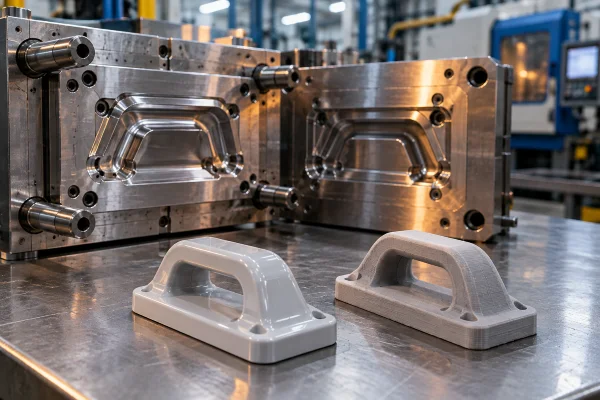
Researchers have measured part of that gap. In a 2002 study in the Rapid Prototyping Journal, printed ABS test pieces reached 65 to 72 percent of the tensile strength of injection-molded ABS made from the same material, at the study's build settings. A crack in a printed part may not show up in the molded one. And a print can't show you sink marks or warping, because those come from the molding process itself.
That's why we prototype at the manufacturer. The molds and tools go to the factory, and the factory runs a first trial, called T1. We tweak the design from what T1 shows, T1 becomes T2, and the loop repeats until the product is ready to sell. Before full production, you get a functional production sample to approve.
Steel rounds cost more than print rounds, and the gap shows up in every row:
| Print round, before the mold | Steel round, after the mold | |
|---|---|---|
| Who builds it | Our industrial designers, in our own studio | The factory, from a mold machined from hardened steel for your part alone |
| Cost of a change | Revising a print costs little | Recutting a steel mold after production starts costs thousands of dollars |
| Time for a change | Same week, with printers and designers in the same building | Weeks |
| What it can answer | Shape, fit, feel, whether the mechanism works | Strength, finish, shrink and snap fits in production plastic |
| Cost of a missed error | Design errors cost hundreds to fix | Manufacturing errors cost tens of thousands |
In our manufacturing process, the people who designed the part check the tooling, because it's usually the single largest upfront cost.
Some testing has to wait for steel. For a children's product, the rule's definition of identical allows no difference that affects compliance between the samples tested and the product you sell. So plan that testing for factory samples.
When should you stop printing? The 2026 steel test
Stop printing when the questions you have left can only be answered by molded parts. Then put the money into steel and plan T1 and T2 as your final rounds.
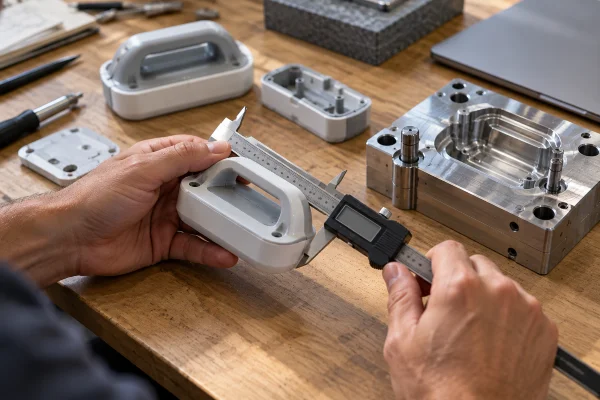
The most common advice says to stop when you stop learning. We think that rule keeps inventors printing too long. A print can keep teaching you things for months, and some of those lessons won't carry over to the molded part. Every extra round before steel is money you won't have for the samples that decide whether you can sell.
Run this check before you pay for another print round. If all 4 answers are yes, stop printing and commit to tooling.
- Does the works-like model do its job every time, in the hands of someone who didn't design it?
- Do your open questions depend on production material, like strength, finish, shrink or snap fits?
- Has a design for manufacturing review cleared the draft angles, wall thickness and tolerances?
- Does the factory's quote hit a unit cost your price can carry?
We run a final check on every decision before production tooling is committed, because mistakes at that stage are the most expensive to fix. The steel test is the inventor's version of that check.
Don't wait for perfect, either. Our sourcing team, back from a factory tour across China that covered roughly 15 to 16 cities, aims to land new designs at 80 to 90 percent of the original concept. Insisting on 100 percent can keep a product from ever reaching production. Factories often need room to adapt tooling, materials or processes for something that's never been made before.
That doesn't mean shipping half a product. HandiBru owner James Wittman put it plainly: "You don't want to come out with a product that's half of what you thought it was going to be." Our studio motto draws the line: make the idea functional first, then put a shell around it.
Plan the count before you print. A 2014 study presented at an ASME engineering conference tested a prototyping planning tool built around 6 decisions, including how many iterations to build. In a controlled experiment and a capstone design class, teams that used it built prototypes with higher functional performance than teams that didn't. The teams were students, but the lesson holds for inventors: decide what each round has to prove before you pay for it.
How many prototypes do you need for your type of product?
The more unknowns your product carries, the more rounds it takes: a simple housewares item may take about 2, while anything with a mechanism or electronics takes more. Each round answers a different question.
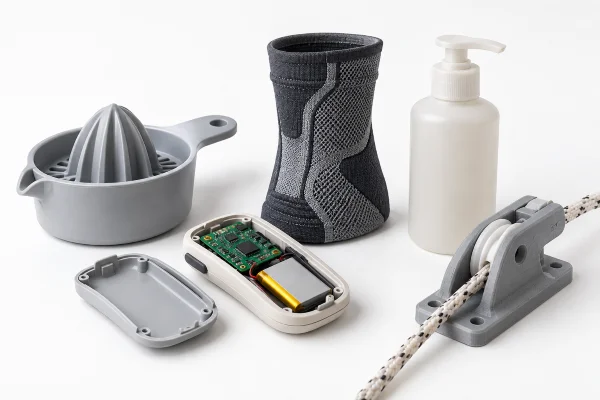
| Product type | What adds rounds | Where most rounds happen | From our work |
|---|---|---|---|
| Housewares and kitchen | Size, shape, fit | Prints before steel, then factory sourcing | LavaLunch: finding factories for the bag and heat packs, then cutting the minimum order |
| Mechanism or impact | Durability, attachment, wear | Works-like rounds | KlockIt Golf: a new core so the ball stays on the rope |
| Electronics | Housing geometry, circuit layout, unit cost | Works-like rounds, then cost-down rounds | Eggmazing: design rounds to cut factory cost without losing its main features |
| Wearables and soft goods | Fit on different bodies and joints | Variants within each round | HurtSkurt: prototyped for a knee, an ankle and an elbow |
| Liquids and formulas | Container, closure, packaging | Packaging samples | Unshrinkit: sampled packaging types before settling on its container |
| Children's products | Safety rules, lab testing | After steel, on production-identical samples | Dozens of kids' products launched; lab testing under 16 CFR 1107 |
Electronics change the cost math, too. When founders price a product from a parts list, we tell them to triple the total as a baseline. If the parts need a circuit board, software or licensing, multiply it by as much as 10.
Eggmazing shows how late rounds can be about cost. The spinning egg decorator arrived as a rough 3D model that wasn't ready for mass production. Its geometry and electronics had to change for a factory, and the savings from those design rounds left the inventor money for marketing.
Why Dyson's 5,127 prototypes is the wrong benchmark
Dyson's number gets quoted as proof that more prototypes make a better product. It's a bad target for a self-funded inventor.
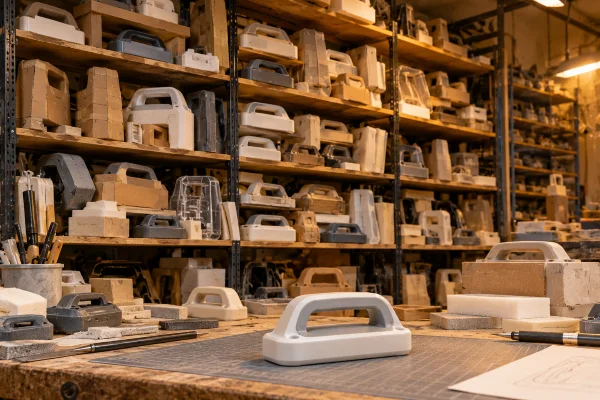
By Dyson's own account, it took 5,127 prototypes before his first cyclonic vacuum was ready for production. The European Patent Office's profile of him says the cost of building those prototypes and filing his patents nearly bankrupted his company. He was solving a new engineering problem. If your product improves on something people already use, it needs answers to its own open questions, not a years-long search.
In our experience, only about 10 percent of product ideas are strong enough to move into development. Prove the idea first, then count prototypes against your open questions.
The answer to "how many prototypes do you need?" has 2 parts: enough print rounds to answer every question a print can answer, then the factory samples that answer the rest. Of the hundreds of brands launched with our studio, 95 percent are still selling today. Bring a sketch, a CAD file or a description to a free consultation. It covers feasibility, timeline and a realistic budget range, so you'll know what your rounds cost before you pay for one.
Frequently asked questions
How many prototypes do I need for a simple product?
In our studio, a simple housewares item may take about 2 rounds. Products with a mechanism or electronics take more, because each round answers a different question. Either way, plan for at least 1 production sample from the factory before you place the full order.
How many prototypes do I need before making an injection mold?
Keep printing until your works-like model does its job every time and a design for manufacturing review clears the draft angles, wall thickness and tolerances. Then cut steel and treat the factory's trial shots, T1 and T2, as your final rounds. Tooling is usually the single largest upfront cost in manufacturing, so it's the step to get right.
Does a 3D-printed prototype prove the final product will work?
Not on its own. A print proves shape, fit and basic function, but it isn't the same plastic made the same way. In a 2002 study in the Rapid Prototyping Journal, printed ABS test pieces reached 65 to 72 percent of the tensile strength of injection-molded ABS. Strength, finish and snap-fit questions need factory samples.
What's the difference between a looks-like and a works-like prototype?
A looks-like prototype checks appearance and feel, and its final versions match the product's real colors, materials and finishes. A works-like prototype checks function: it carries the mechanism or electronics, even if it looks nothing like the finished product. Some products need both, and they're often built at the same time.
How long does a prototype round take?
When the printers and designers share a building, a change made in the morning can be in your hand the same week. An outside print bureau adds days of waiting to every change. Rounds after the mold take longer, because recutting a steel mold costs thousands of dollars and weeks of time.
Can I skip prototyping and go straight to manufacturing?
You can, but it's the expensive way to find mistakes. Design errors cost hundreds of dollars to fix, while manufacturing errors cost tens of thousands and usually show up after the money is spent. Even with a finished design, approve a functional production sample before the full order.
Do I need a patent before I build a prototype?
No. Product development can start at any stage, and 52Launch works with patent attorney partners and keeps your idea confidential. A patent also won't tell you whether a factory can build your product, because a patent attorney judges patentability, not manufacturability.