There's a lot of noise in the product development space. Designers, licensing firms, marketing agencies, overseas manufacturing companies — everyone promises to be the missing link that you need. But what happens when you've paid for all those pieces and still don't have a product on a shelf?
That's the basis of the conversation Dan Gonyea and Jon Ambrose had on a recent episode of the Pitch to Product Podcast. Here are their 6 insights you need to know in order to avoid wasting valuable time and money.
1. Product Development Misconceptions
There are many companies that will make your product. Or more accurately, there are many companies that will make one aspect of your product. A great design firm will make you beautiful renderings of your idea, but when you ask how to get your product manufactured, they just shrug their shoulders. Then you find a factory, only to be told that your product isn't designed for manufacturability. After all that time and money, suddenly you're back at square one.
"By the time you end up adding all those costs up," Gonyea said, "you're pretty close to what we charge for everything under one roof."
2. All-In-One Product Development
At 52Launch, the pillars of product development are industrial design, marketing, and manufacturing. Most people assume the process flows in that order: design a great product, make it, then sell it.
Jon Ambrose, Chief Operating Officer at 52Launch pushes back on that: "That's backwards. That's wrong."
Real marketing isn't just selling; it's also understanding what your target audience actually cares about, what they're willing to buy, and why. That research has to happen before design begins, not after. Otherwise, as Ambrose puts it, "you're building the wrong thing."
At 52Launch, the design team and marketing team sit side-by-side, sparking constant collaboration that allows the company to move efficiently and catch problems early before they become expensive.
3. The Costs of Product Development
52Launch operates on a flat fee model. According to Gonyea, more than a few industry experts told him it was a terrible idea: "You're going to get killed in that scenario."
And yet, the model works. This is because it's built around a defined set of deliverables in each area — marketing, design, and manufacturing — with client sign-off along the way. Clients have approval rights roughly a dozen times throughout the product development lifecycle. Nothing moves forward without alignment.
The key concept that makes the flat fee sustainable is what 52Launch calls the minimum successful product — the simplest, most polished version of a product that genuinely solves the customer's problem and can be manufactured at the right price point. Not a watered-down version of the vision, but a smart and focused first run that gets real products into real customers' hands.
"Go slow to go fast," Gonyea says. "Go slow upfront to really be clear about what is being built and why."
4. The Right Production Strategy
52Launch keeps manufacturing quantities intentionally small, typically a few hundred to a few thousand units. This isn't a limitation, but a key feature.
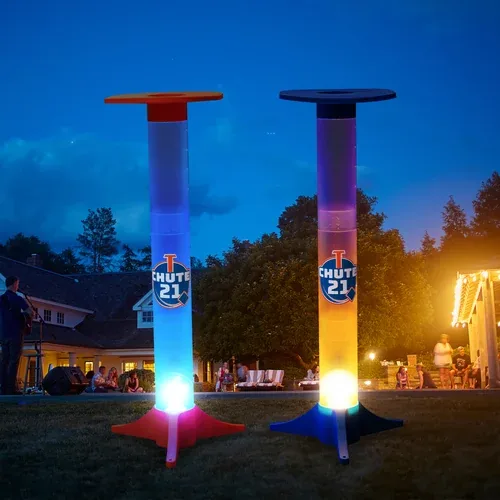
The reasoning is simple: get product to market, collect real customer feedback, iterate, then scale. Gonyea knows from experience what happens when you skip that step. 52Launch produces their own products through a subsidiary, NRG Brand Management. These products include a backyard game called Chute 21. Two versions of Chute 21 were launched — a standard edition and a glow-in-the-dark version priced $10 apart.
"Come to find out, no one wanted the regular," said Gonyea. "They all wanted the glow."
Had they gone all-in on a large order of both, they'd have been stuck with thousands of units that customers didn't want. The lesson: test first, scale later.
5. How To Build Manufacturing Relationships
One of the less visible, but arguably most valuable, parts of what 52Launch does happens quietly in factories overseas.
"We've built relationships for 30 years with these factories," Gonyea said.
Those relationships mean factories will run small orders for 52Launch, knowing that reorders follow successful launches. 52Launch employees are on the ground in China, Vietnam, and Bangladesh doing quality control inspections. The company even helps its manufacturing partners market their own products, a level of mutual investment that creates genuine trust and loyalty on both sides.
For a first-time inventor trying to cold-call overseas manufacturers, small-quantity production is nearly impossible to access. For 52Launch clients, it's standard.
6. How To Be An Entrepreneur
Ambrose makes it clear that being an all-in-one partner doesn't mean that 52Launch runs your business for you. In his words: "We can't be the CEO of 700 clients."
The clients who get the most out of the process are the ones who stay engaged, ask questions, communicate their vision clearly, and treat 52Launch as a partner rather than a vendor. The company brings the expertise, the relationships, and the infrastructure. The entrepreneur still has to drive the dream.
"Ask questions if you don't understand something," said Ambrose. "Make sure the other side understands what you want. Be proactive throughout the whole process."
Get Started Creating Your Product
52Launch isn't for everyone; If you've already got design done, or you're only looking to license a product, or you want a company that will buy your idea, there are other places better suited for where you are.
But if your goal is to get a product to market — to actually create revenue and profit — Gonyea makes the case plainly: "We're that company. We're quite frankly the only company that does that."
Ready to turn your product idea into a reality and get it to market? Contact us today at 52 Launch to get started.