You make a product more sustainable without raising the cost by cutting before you swap. Remove parts, features and material while the design is still in CAD, size the box to the product, and order only what you can sell. Those cuts lower your unit cost or keep cash out of stock nobody buys. Swaps to recycled, bio-based or compostable materials are where cost can climb, so price them last. A 2015 study prepared for the European Commission estimates that more than 80% of product-related environmental impacts, along with the major life cycle costs, are set during design.
That's why our studio in Framingham, Massachusetts, designs every product to be manufactured from day one. 52Launch has launched 730+ consumer products with 170+ manufacturing partners, and the cheapest sustainability gains show up before anyone cuts steel.
What Makes a Product More Sustainable?
A product gets more sustainable when it uses less material and energy to make, lasts long enough to cut replacements, and has a real end-of-life path where it's sold. The last part is the hardest to prove. "Recyclable" and "compostable" only count if local programs take the item, and the FTC and California set rules for saying so.
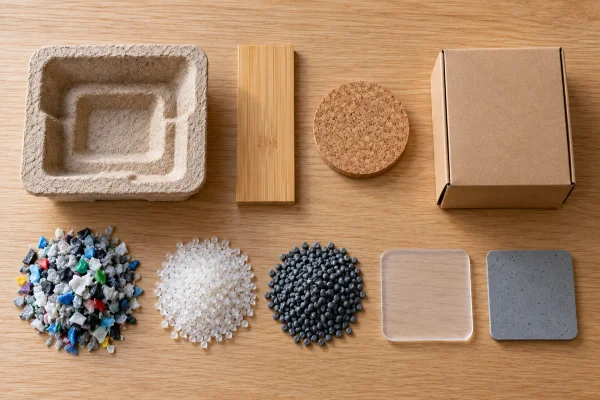
Eco-friendly and sustainable get used as if they mean the same thing. They don't. Eco-friendly usually describes a single trait, like a plant-based plastic. Sustainable covers the whole life of the product: what it's made of, how it's made and shipped, how long it lasts and where it ends up.
Why Do Sustainable Products Cost More?
Most of the extra cost comes from swaps: a specialty resin, a certification test or a higher minimum order. Cutting material moves cost the other way.

Timing matters as much as the change. Our manufacturing team's rule of thumb is that a design error costs hundreds to fix, while a manufacturing error costs tens of thousands. Sustainability changes follow the same math. They're cheap in CAD and expensive once the mold is cut.
When a swap does add cost, the market may pay for it. NYU Stern's Center for Sustainable Business tracks this with Circana sales data. In its 2025 index, sustainability-marketed products held 25.4% of branded consumer packaged goods sales, up 1.6 points in a year, and drove 44.9% of the category's growth from 2013 to 2025. The center's 2024 analysis found a 26.6% price premium over conventional versions.
Sustainable Changes and What They Do to Cost
| Change | Effect on cost | Why |
|---|---|---|
| Merge or remove parts in CAD | Lowers unit cost | Less material to buy and fewer tools to cut. Tooling is usually the single largest upfront cost. |
| Cut features you can't justify | Lowers unit cost | Fewer parts to build, and a second feature roughly doubles the ways a product can fail. |
| Size the box to the product | Lowers unit cost | Less board per unit and more units per carton. |
| Order what you can sell through | Lowers total spend | Stock nobody buys wastes cash and material. |
| Book standard ocean freight early | Lowers freight cost | A fast boat through Long Beach costs about 20% more. |
| Switch to recycled or bio-based plastic | Can raise or hold cost | Price depends on the resin, the color and your order size. |
| Switch to compostable plastic | Adds testing and label work | California requires compostable plastic products to meet ASTM D6400-19. |
The first 4 rows cut cost and material together. The last 2 are where budgets slip, so price them before you commit.
Make a Product More Sustainable in CAD, Where Changes Cost the Least
Make the big sustainability calls in CAD, because that's where material, part count and product life get set. A change there costs a reprint instead of a recut mold.
Our studio runs 5 product development stages under one roof: design, rapid prototyping, manufacturing, branding and marketing. Sustainability choices belong in the first 2.
Cut Parts Before You Swap Materials
Every part you remove is material you never buy, mold or ship. Before anyone debates bioplastics, look for 2 parts that could become 1, screws a snap fit could replace, and walls thicker than the product needs. Our guide to design for manufacturing covers the thinking behind it.
Simple products also cost less to build and fail less. Our team's rule of thumb is that adding a second feature roughly doubles the ways a product can fail. And a product that breaks in month 3 isn't sustainable at any resin price.
Prototype in the Material You'll Ship
A 3D print shows whether the shape works. It can't show how a recycled or plant-based resin behaves in a steel mold. That's why the looks-like prototypes in our rapid prototyping studio are built to match final colors, materials and finishes.
Testing early is cheap. A $20 print is a fine place to find a problem, and a $20,000 mold is a terrible one. Recutting a steel mold after production starts costs thousands and takes weeks.
Sustainable Materials and What They Do to Your Quote
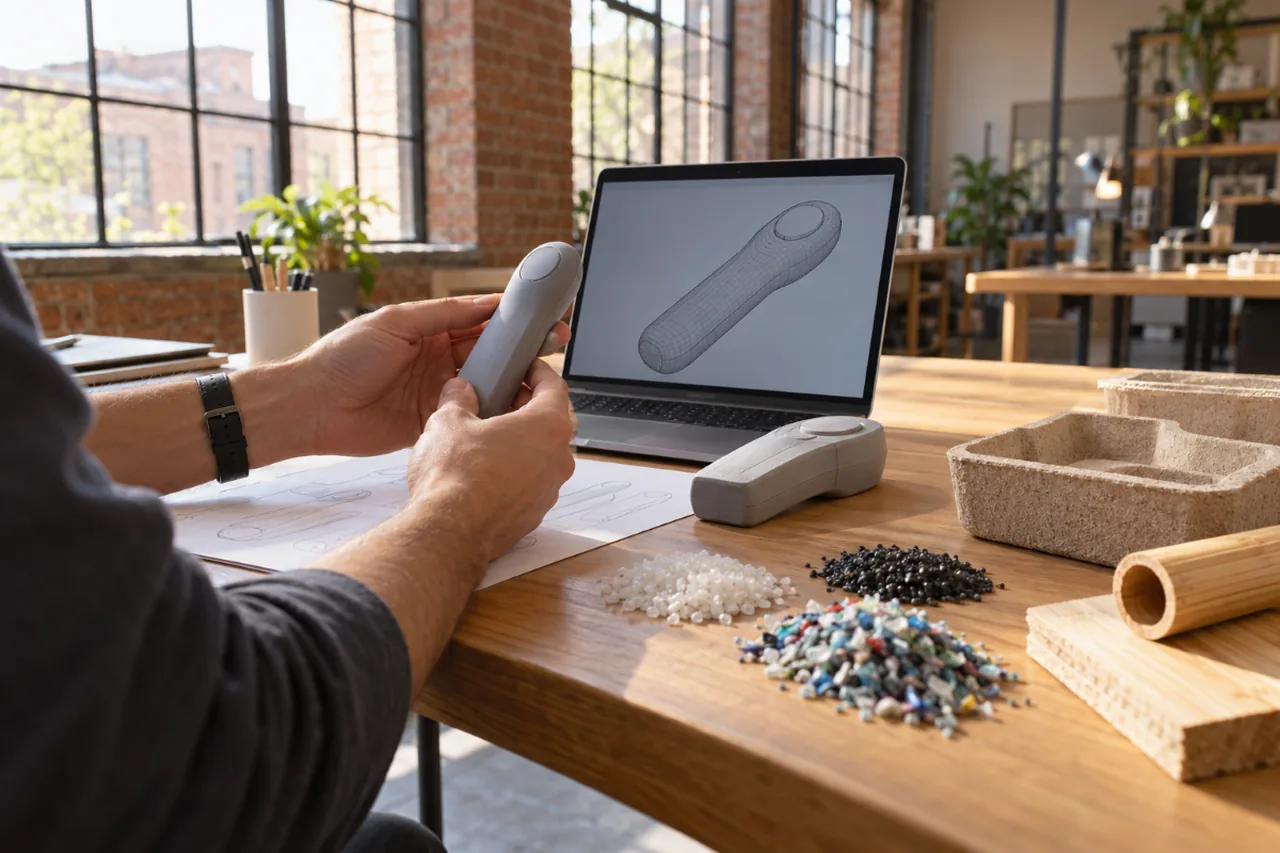
Recycled plastics and drop-in bio-based plastics are the easiest swaps, because they process like the plastic they replace. Compostable plastics and natural-fiber blends can work, but they change more at the factory and on the label. In our product development services, the material call happens in CAD and gets checked against unit-cost targets before any tool is cut.
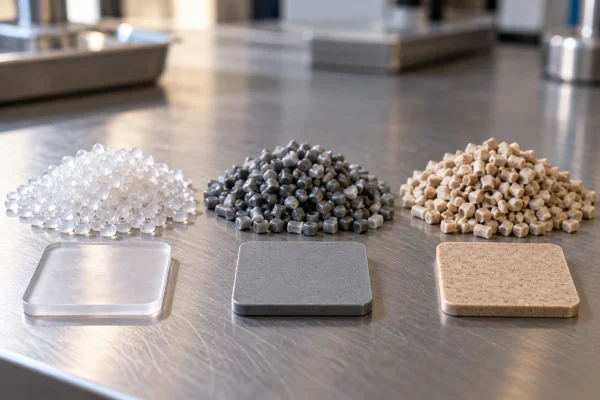
Sustainable Material Options, Side by Side
| Material | What changes at the factory | Cost to watch | Claim rules to check |
|---|---|---|---|
| Post-consumer recycled plastic, or PCR | Often runs in the same mold as new plastic of the same type. Color and smell can vary by batch. | Resin price and color matching | State the recycled percentage by weight unless the whole product is recycled content |
| Post-industrial recycled plastic | Runs like PCR, with supply tied to factory scrap | Steady supply at your volume | Keep proof the scrap would otherwise have gone to waste |
| Drop-in bio-based plastic, such as sugarcane PE | Processes like the fossil-based version | Resin price at your order size | Bio-based doesn't mean compostable, so don't imply it |
| Compostable plastic such as PLA or PHA | Narrower processing window. PLA softens at lower heat. | Certification testing and label changes | In California, meet ASTM D6400-19. Qualify the claim under FTC guidance. |
| Natural-fiber blends with wood, bamboo or flax fill | Fibers change flow, finish and strength. Test in the real mold. | Mold trials and extra testing | California restricts "biodegradable" claims |
None of these has a universal price. The premium depends on the resin, the color, your order size and what the factory already stocks. Ask for every option quoted at the same quantity, or you'll end up comparing 2 different jobs.
What a Material Switch Does to MOQ, Tooling and Freight
A new material can raise your minimum order, change your mold and stretch your lead time. Price the switch before you commit to it.
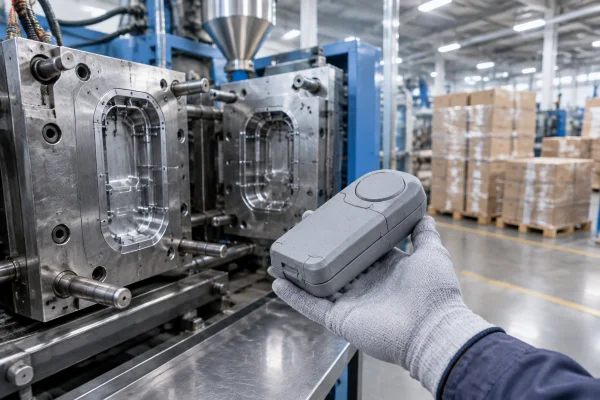
First production runs we manage typically start at 1,000 to 2,500 units, and tooling costs the same at any order size. MOQs vary by process and material, so a specialty resin can push yours up. Our manufacturing team has a warning for that moment: a low unit price means little if it forces you to buy 10 times more inventory than you can realistically sell.
Unsold stock is the least sustainable product there is. It uses all of the material and gets none of the use.
Minimums can move. Take the LavaLunch project, an insulated lunch bag with microwavable heat packs. Our team found manufacturers that could make the bag and the heat packs and assemble them before shipping, then worked with them to lower the minimum order for the first sales round. Early sales and the cost savings let the client place a large production order next.
Freight belongs in the math too. On orders from China, a fast boat through Long Beach arrives about 20 days sooner than standard ocean freight through the Panama Canal and costs about 20% more. Booking early lets you take the cheaper boat. Air freight is for samples. If a production run has to fly, the schedule broke somewhere upstream.
Closer to home isn't automatically greener or cheaper. We compare U.S. and overseas costs, timelines and tariffs for each product across our 170+ partners, and the answer changes by product.
Is Compostable Plastic Worth It?
Usually not. For most consumer products, compostable plastic adds testing and label work, and most buyers have nowhere to send it.
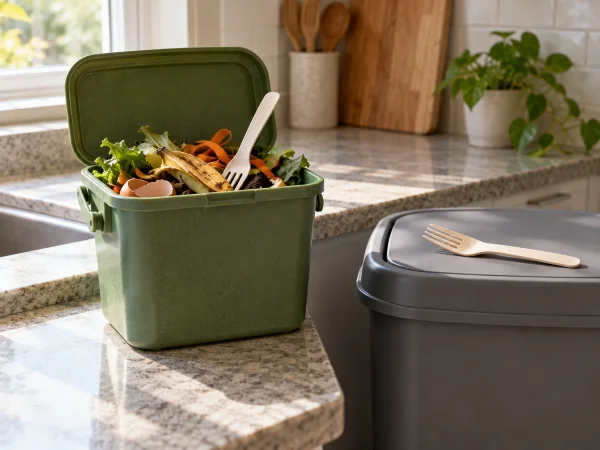
The Sustainable Packaging Coalition's 2025 access data found that 18.1% of the U.S. population it studied can send food waste plus some compostable packaging to a program that takes it. That sample covered 60% of the U.S. population. For everyone else, a compostable part most likely ends up in the trash.
The FTC's Green Guides say a compostable claim needs qualifying when composting facilities aren't available to a substantial majority of the people where the item is sold. For recyclable claims, the same Guides set a substantial majority at 60% or more. 18.1% is nowhere close.
California adds its own test. Compostable plastic products sold there must meet ASTM D6400-19, and starting June 30, 2027, compostable consumer products must be made of materials allowed as agricultural organic inputs.
Recycling isn't a free pass either. EPA's latest national figures put the U.S. plastics recycling rate at 8.7% in 2018. So the move that works everywhere, and costs the least, is less material in a product that lasts. Compostable earns its place when a product gets used with food and thrown out with food, somewhere that collects both.
Sometimes the most sustainable product keeps another one in use. Unshrinkit's solution brings shrunken wool sweaters, hats and blankets back to size. A sweater that fits again is a sweater nobody has to replace.
Packaging Is the Easiest Place to Cut Cost and Material
Cut packaging first. It's the quickest place to remove material, and the savings show up in your unit cost.
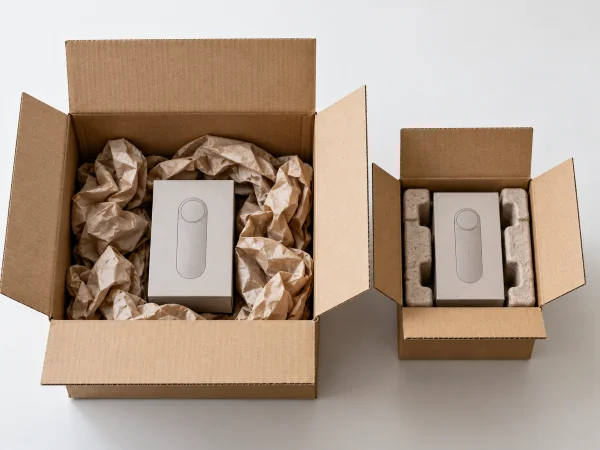
Containers and packaging made up 82.2 million tons of U.S. municipal waste in 2018, or 28.1% of everything generated, according to EPA. Only 13.6% of plastic containers and packaging got recycled that year.
Our branding team holds packaging to a 3-part test: it has to fit the product, survive shipping and land at a unit cost the margin can carry. Unshrinkit's founders came to us for new packaging and a lower price per bottle. The challenge was cost-effective packaging that could safely hold the formula. We designed and sampled packaging options before landing on the classic Unshrinkit container, then found a domestic chemist to make the formula at scale.
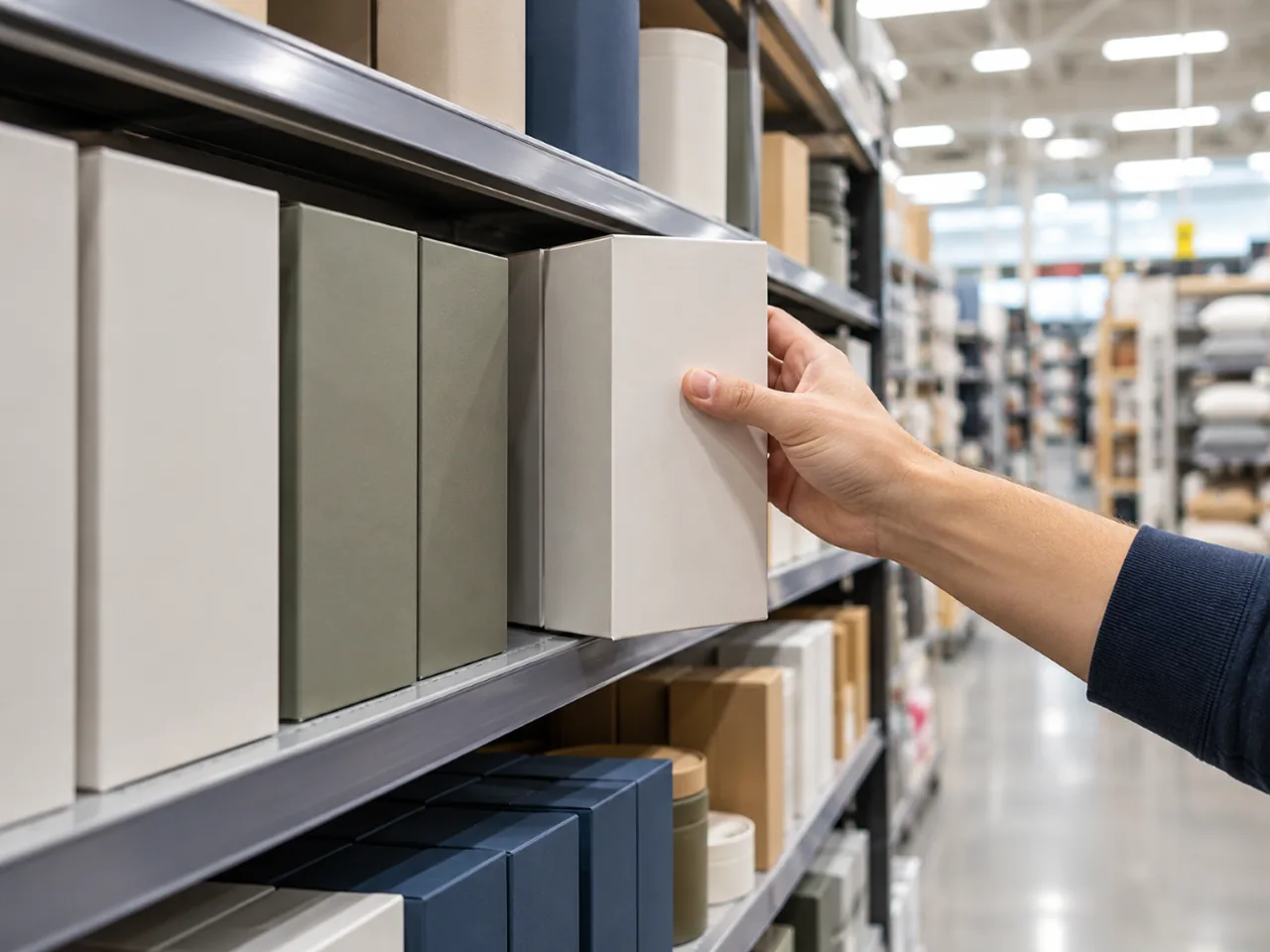
Size the box to the product. Use a single material where you can, since mixed materials are harder to recycle. And leave the chasing arrows off until you've checked the label rules in every state you sell in.
What Can You Put on the Label in 2026?
Only claims you can prove where you sell. An unqualified "recyclable" claim has to clear the FTC's 60% threshold nationwide, and in California it also has to pass the SB 343 test. Getting it wrong after you print means paying for the boxes twice.
What Each Label Claim Takes
| Claim on your label | What it takes |
|---|---|
| "Recyclable" or the chasing arrows, in California | For products and packaging made after October 4, 2026: accepted by recycling programs serving at least 60% of Californians, and sorted by large facilities serving at least 60% of the state's recycling programs, or qualifying under one of the law's alternative paths. |
| "Recyclable" nationwide, under FTC guidance | An unqualified claim needs recycling facilities available to at least 60% of consumers or communities where the item is sold. Below that, qualify the claim. |
| "Compostable" | Competent and reliable scientific evidence that every material breaks down into usable compost in a safe and timely manner. Qualify the claim if composting facilities aren't available to a substantial majority. In California, plastics must meet ASTM D6400-19. |
| "Made with recycled content" | Material recovered or diverted from the waste stream. If only part of the product is recycled content, state the percentage by weight. |
| "Biodegradable" | California restricts marketing products with this term. |
One caveat on timing. A federal court blocked enforcement of the SB 343 labeling restrictions on July 14, 2026, and CalRecycle says the timeline may change. We'd still design labels to the rule. This section summarizes the rules. It isn't legal advice, so have an attorney review your labels before you print.
6 Questions That Keep a Material Switch From Raising Your Cost
Get these answered in writing before you change a resin, a finish or a box.
Ask in person if you can. On a recent sourcing trip, our team spent nearly 3 weeks visiting factory partners in 15+ cities across China, with 30 to 45 active factory projects in play. In-person visits matter because a single color swatch question can take a full day by email across a 12-hour time difference.
- Does every quote use the same order quantity, so you're comparing the same job?
- What's the MOQ for each material option at the same color and finish?
- Can the new material run in the current mold, or does the tool need changes?
- How much will color and finish vary from one batch to the next?
- Which document backs the claim: a recycled-content certificate or an ASTM D6400 compostability certification?
- Who runs drop, heat and wear tests on the new material, and when do results come back?
If you want to make a product more sustainable without raising the cost, bring this list to your design review instead of your final factory quote. Design, prototyping, manufacturing, branding and marketing all happen under one roof in our Framingham studio, so the material choice, the cost and the label get decided together. Book a free consultation, and we'll map feasibility, timeline and a realistic budget range for your product.
Frequently Asked Questions About Making a Product More Sustainable
What Is the Cheapest Way to Make a Product More Sustainable?
Remove parts, features and packaging material while the design is still in CAD. A 2015 study prepared for the European Commission estimates that more than 80% of product-related environmental impacts, along with the major life cycle costs, are set during design.
Does It Cost More to Make a Product More Sustainable?
Not when the change is a cut, such as fewer parts or a smaller box. It can when the change is a swap to a specialty resin or a certified compostable material, so get every option quoted at the same order quantity. Timing matters too: at 52Launch, a design error costs hundreds to fix, while a manufacturing error costs tens of thousands.
Is Compostable Plastic Better Than Recyclable Plastic?
Not for most consumer products. The Sustainable Packaging Coalition found that 18.1% of the U.S. population it studied can send food waste plus some compostable packaging to a program that accepts it. The FTC's Green Guides say compostable claims need qualifying when composting facilities aren't available to a substantial majority of people where the item is sold.
Can I Put a Recycling Symbol on My Product?
Only if the item is recyclable where you sell it. In California, products and packaging made after October 4, 2026 can't show the chasing arrows unless programs serving at least 60% of residents accept the item and large facilities serving at least 60% of the state's recycling programs sort it, or it qualifies under one of the law's alternative paths. A federal court blocked enforcement on July 14, 2026, so check the current status with an attorney before you print.
Do Customers Pay More for Sustainable Products?
Often, yes. NYU Stern's Center for Sustainable Business found that sustainability-marketed products held 25.4% of branded consumer packaged goods sales in 2025. Its 2024 analysis measured a 26.6% price premium over conventional products.
Is It More Sustainable to Manufacture in the U.S. Than Overseas?
Not automatically. Materials, energy, freight and order size all change the answer, so compare options product by product. 52Launch compares U.S. and overseas costs, timelines and tariffs across 170+ manufacturing partners for each product.